Showing posts with label IVF outcomes. Show all posts
Showing posts with label IVF outcomes. Show all posts
Era of big data - Taiwan Fertility Centre apply advance technology for donor - recipient matching
6/30/2019 12:36:00 AMEra of big data - Taiwan Fertility Centre apply advance technology for donor - recipient matching
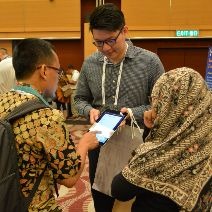
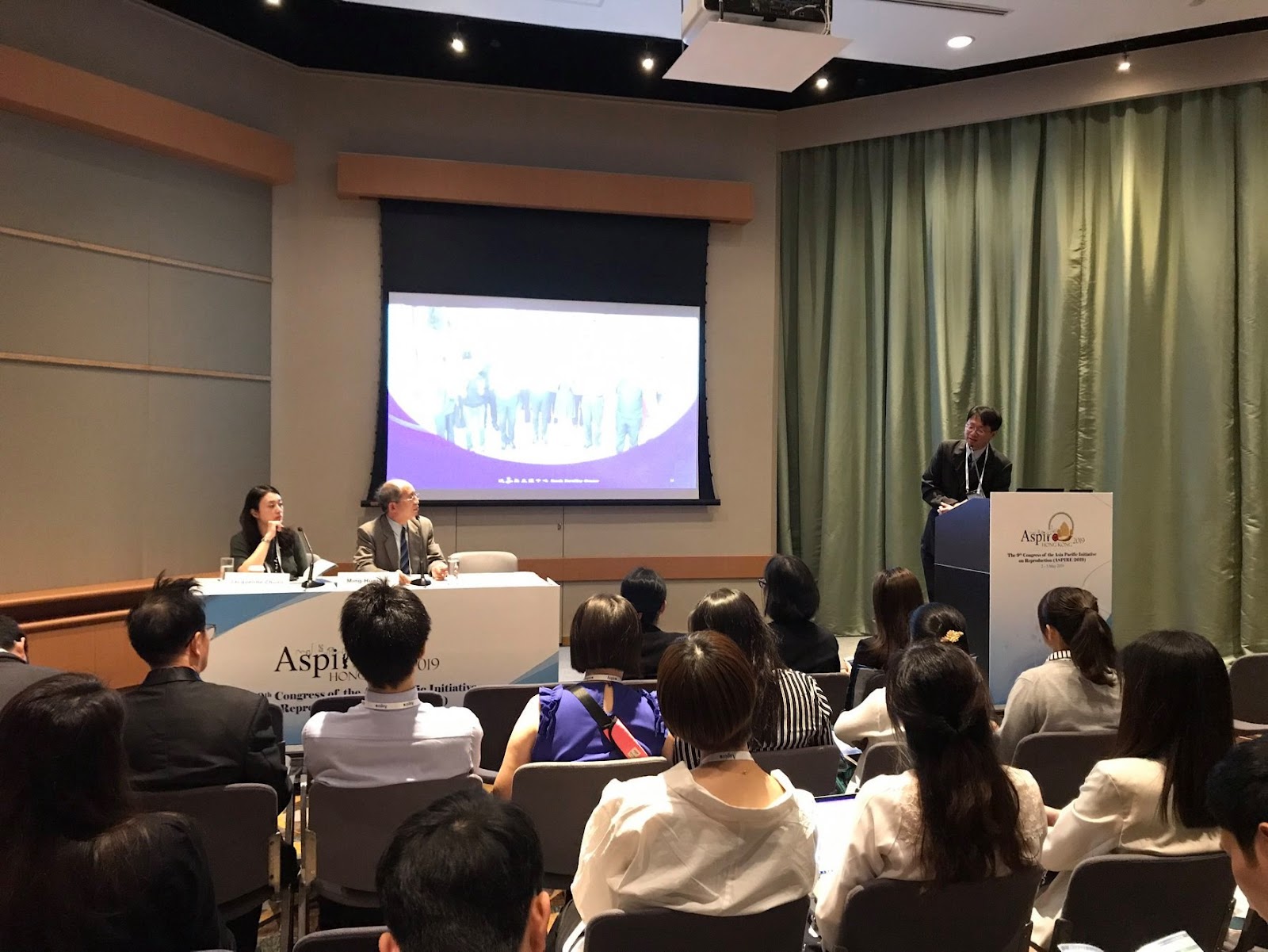
Taiwan Fertility Centre participated in Aspire 2019 Asia Pacific Initiative on Reproduction. Aimed to share our studies at freeze oocytes and the usage of big data at our iconic oocytes bank of Asia. Oral presentation lead by Dr. Meng-Ju Lee, MD and our Academic group leader Andi, study about the best insemination time for thawed-oocytes. And we achieved at using average 6 eggs for 1 baby delivered. With our experience and data of over 20,000 thawed- oocytes, our thawed-oocytes survival rate, fertilization rate, and blastocysts rate, all of those are world-class. We also demonstrated the latest system we use for matching oocytes donor and recipient. The system uses the calculation of big data.
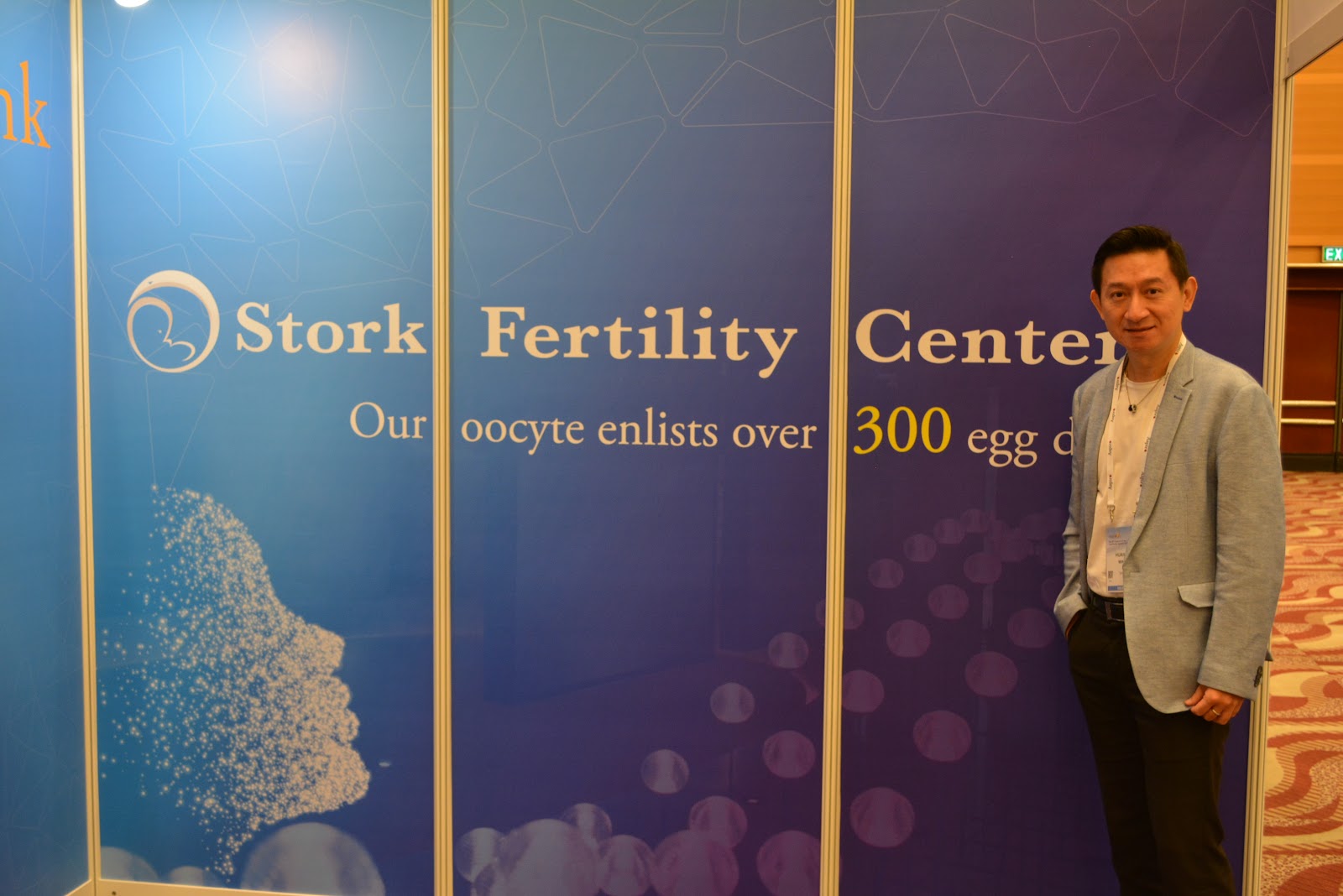
Since 2005, Stork Fertility Center start to provide oocytes donation and acceptance. Stork Fertility Centre enlists over 300 donors, with a sufficient supply of each blood type, no long waiting matching process. Every donor pass through high-standard health assessment: Chromosome Karyotyping, drug screening, infectious disease screening, Spinal Muscular Atrophy.

From 2009 to 2019, over 5,353 cases successfully got pregnant using donated oocytes, takes over 50% in Taiwan region. In order to provide a better and complete service for the recipient family, we are now using big data for matching. Use AI rather than manually, we hope we can provide a more caring, intimate service.
 Register:Oversea Form
 Facebook:e-Stork FB Page
IVF Journey x Blastocyst Accumulation
8/27/2018 07:39:00 PM

Several studies have shown maternal age as a determining factor in IVF treatment.
Most of our patient are suffered from diminished ovarian reserve and/or advanced maternal age. For women over 38-year-old, with declined ovarian reserve, accumulating blastocysts is the strategy we use. Both the quality and quantity of oocytes are adversely affected by the age. They may experience repeated IVF failure caused by few or no embryos to transfer. In this cohort, accumulating blastocysts could be used to increase the chance of pregnancy.
What is oocytes accumulation? What is blastocysts accumulation?
Oocytes accumulation aimed at collecting oocytes, and freeze it. After we had collected enough oocytes, we thaw all oocytes and fertilize and culture them in one batch.
Blastocysts accumulation aimed at creating blastocysts and freeze it. After each oocyte retrieval surgery, we fertilize the eggs and culture till day 5~6 then freeze it.
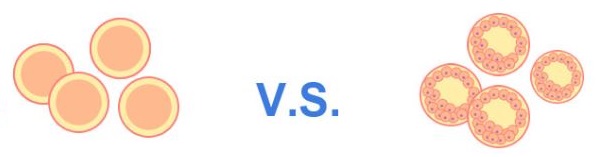

The clinical outcomes of different age using different treatment shown.
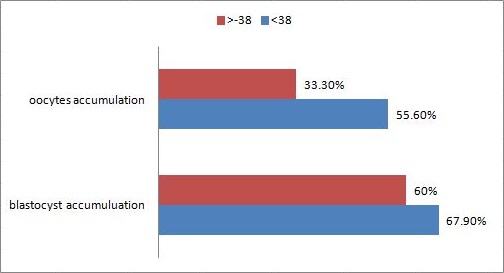
But the pregnancy rate of oocytes or blastocyst accumulation did not show a significant difference.
To conclude, for age under 38y/o, the pregnancy rate can be reached around 50~70% regardless of what treatment is used; however, forage over 38y/o, the pregnancy rate will be double using blastocyst instead of oocyte
the pregnancy rate of age over 38y/o is nearly double that of the ovulation pregnancy rate.
How many blastocysts should I collect?
Without pre-implantation genetic screening(PGS), the basis for embryo implantation can only be judged by the developmental speed and appearance level.
Therefore, the pregnancy rate and live birth rate vary with age.
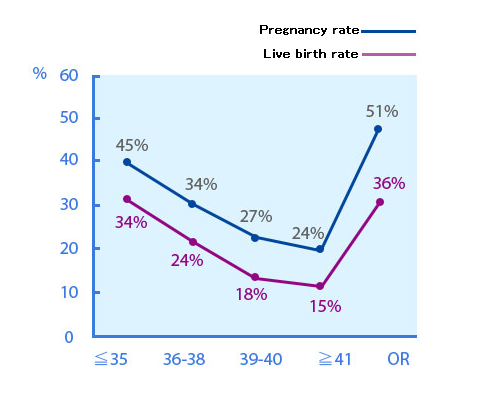
The estimated fee for both treatments is as follow.

To increase the pregnancy rate and live birth rate furthermore, we introduce you the Third generation IVF Plus( PGS + ERA) . For further require, please contact us
Leave a message down below, we are more than willing to answer!
Register:Oversea Form Facebook:e-Stork FB Page E-mail:en_service@icryobank.com
 WhatsApp:+886-905-737-501
Double stimulation (Duo-OPU)
5/24/2017 06:49:00 PM

— Continuous stimulation and oocyte retrieval during both the follicular and luteal phases of poor responders in IVF/ICSI programs can increase the obtained oocytes per menstrual cycle
The secret of age—maternal age and embryo aneuploidy
11/08/2016 05:05:00 PM

The chromosomal abnormality (aneuploidy)
rate increases with maternal age.
By analyzing with next-generation sequencing, more precise information can be obtained.
Preimplantation genetic screening (PGS) is an examination to screen the embryos with abnormal dosage of
chromosomes (aneuploid) in the IVF realm, and it is strongly recommended to the
women with advanced maternal age or undergoing recurrent miscarriage. By
excluding the aneuploid embryo transfer, the success rate of IVF can be
significantly improved.
A patient friendly corifollitropin alfa protocol without routine pituitary suppression in normal responders
6/07/2016 06:26:00 PM

Author
|
Huai-Ling Wang1, Hsing-Hua Lai1, Tzu-Hsuan Chuang1, Yu-Wei Shih1, Shih-Chieh Huang1, Meng-Ju Lee1, Shee-Uan Chen2
|
Affiliation
|
1Stork Fertility Center, Stork Ladies Clinic,
2Department of Obstetrics and Gynecology, National Taiwan University Hospital and College of Medicine,
|
Publication
| |
Keywords
|
Corifollitropin alfa; Controlled ovarian stimulation; GnRH antagonist
|
Introduction
Reducing the frequency of injections in an in vitro fertilization (IVF) program is a patient-friendly way to decrease the mental stress and financial burden in infertile couples. The release of corifollitropin alfa simplifies daily injections of short-acting recombinant follicular stimulating hormone (rFSH), and its widely-used protocol involves short-acting gonadotropins supplements and a fixed GnRH antagonist regimen, largely based on follicle size. In this study, the feasibility of corifollitropin alfa without routine pituitary suppression was evaluated, and it may further simplify the injection protocol.
Assessment of corifollitropin alfa for assisted reproduction: a review study
4/23/2014 12:40:00 AM
Introduction:
Corifollitropin alfa, a fusion product of recombinant human
follicle-stimulating hormone (rFSH) with a hybrid beta subunit C-terminal
peptide of human chorionic gonadotropin, plays a similar pharmacologic role as
traditional rFSH, but with a longer half life.
Clinical applications of corifollitropin alfa in assisted reproductive realm
have reported that it stimulates multifollicular growth for 7 days with the
same safety and ovarian response as rFSH administration. In 2003, the first
report of live birth using corifollitropin alfa stimulation was released in
Netherland. In 2010, European union approved corifollitropin alfa in its
market, and then Taiwan approved the release of corifollitropin alfa in 2013. To
assess the outcomes of corifollitropin alfa in following embryo development of
IVF program, including fertilization, good embryo formation (culture to the day
3), and blastocyst formation (culture to the day 5), we analyzed the results
generated from the cases stimulating by long-acting rFSH (L-rFSH,
corifollitropin alfa) and by traditional rFSH (T-rFSH) shots in this study.
Materials
and Methods:
Study
Cohort I—General
patients
A total of 252 cycles were recruited since
December, 2012 to September, 2013. There were 91 cycles (average age: 34.9 y/o,
range from 28-42) using L-rFSH stimulation (14 cycles with single shots and 77
cycles with T-rFSH supplements), and 161 cycles (average age: 34.9 y/o, range
from 23-40) using T-rFSH stimulation, which was set as the control cohort (Table 1). The patients with polycystic
ovarian symptoms were excluded from the study cohort. Number of antral
follicles, number of retrieval oocyte, hormone levels after stimulating, number
of mature oocytes(MII) after retrieving and the fertilization rates were
compared between the two groups. Then the good embryo rate (GER) of
day3-culture and the good blastocyst rate (GBR) of day5-culture were determined
from each group.

Table
1
Study
Cohort II—Oocyte Donor
Cohort
A total of 89 oocyte donating cycles were
recruited since December, 2012 to September, 2013. There were 64 cycles using
L-rFSH stimulation, and 25 cycles using T-rFSH stimulation, which was set as the
control cohort. The same parameters associated with embryo yield were also
compared in these two groups.
Treatment
Protocol Design
To assess the more friendly protocol to the
IVF cases, we designed a protocol with fewer injections based on the
traditional rFSH short protocol and the corifollitropin α in GnRH antagonist protocol.
The modified protocols were displayed in
Figure 1.

Figure
1
Statistics
Statistical evaluations were carried out
using nonparametric Student’s t test
with Welch’s corrections. The statistical software, prism (http://www.graphpad.com/scientific-software/prism,
GraphPad) was administrated in the data processing.
Results
Although the number of antral follicles showed
difference between L-rFSH recipients and T-rFSH recipients (10.16±0.44 vs. 8.39±0.31, p<0 .01="" font="" nbsp="">
After oocyte retrieving of L-rFSH recipients and T- rFSH recipients, number of MII oocytes (11.16±0.69 vs. 9.52±0.50, p=0.03), maturation rates (75.8% vs. 78.31%, p=0.16) and fertilization rates (78.72% vs. 77.12%, p=0.26) were no different. In following cultural results of embryos, GER of day3 (61.32% vs. 58.22%, p=0.24) and GBR of day5 (60.39% vs. 57.36%, p=0.21) also performed the similar outcomes from the two groups (Figure 2).
After oocyte retrieving of L-rFSH recipients and T- rFSH recipients, number of MII oocytes (11.16±0.69 vs. 9.52±0.50, p=0.03), maturation rates (75.8% vs. 78.31%, p=0.16) and fertilization rates (78.72% vs. 77.12%, p=0.26) were no different. In following cultural results of embryos, GER of day3 (61.32% vs. 58.22%, p=0.24) and GBR of day5 (60.39% vs. 57.36%, p=0.21) also performed the similar outcomes from the two groups (Figure 2).

Table
2 General IVF case
After oocyte retrieving of L-rFSH
recipients and T- rFSH recipients, number of MII oocytes (11.16±0.69 vs. 9.52±0.50,
p=0.03), maturation rates (75.8% vs. 78.31%, p=0.16) and fertilization rates
(78.72% vs. 77.12%, p=0.26) were no different. In following cultural results of
embryos, GER of day3 (61.32% vs. 58.22%, p=0.24) and GBR of day5 (60.39% vs.
57.36%, p=0.21) also performed the similar outcomes from the two groups (Figure 2).

Figure
2
In the oocyte-donor cohort, the group
stimulated by corifollitropin alfa also displayed similar ovarian responses and
clinical outcomes in the following embryo culture (Table 3, Figure 3).

Table
3 Oocyte
donating cycles

Figure
3
Discussion:
Based on the efficiencies of controlled ovarian stimulation and
embryo culture, no significant differences were observed between the recipients
of L-rFSH and of T-rFSH. Due to the long lasting effect of corifollitropin
alfa, a more patient-friendly option with reduced injective frequencies could
be applied to the overseas cases or cases afraid of injections (Table 4, Table 5).

Table
4 Frequency of Injection

Table
5 Cost List
(The study has been published in 2014 Annual Meeting of Taiwanese Obstetrics and Gynecology Society)
References:
1.
A comparison of long-acting FSH
versus daily FSH did not show evidence of difference in effect on overall live
birth rate or OHSS in 2335 IVF participants (Cochrane Database Syst. Review,
2013)
2.
Long-acting rFSH and
short-acting rFSH treatment protocols provided equal success rates of live
birth and cumulative pregnancy
(Boostanfar et al., Fertil Steril 2012)
3.
Treatment of
poor ovarian responders with corifollitropin α in a GnRH
antagonist protocol results in low pregnancy rates, similarly to
conventional stimulation with a short agonist protocol
4.
(Polyzos et al., Fertil Steril
2013)