Showing posts with label Embryo Collection. Show all posts
Showing posts with label Embryo Collection. Show all posts
The Key for Implantation - Endometrium Thickness
12/26/2018 12:25:00 AM

The Key for Implantation - Endometrium Thickness
Stork Fertility Center
Dr. Lee

In IVF, we’ve been discussing the ideal thickness of endometrium for implantation.
Besides, is the criteria the same for both fresh blastocysts and frozen-thaw blastocysts implantation? Will it be the same? We did not have many studies on the above issue.
This September(2018), Human Reproduction, a research team from Canada, using the database of local IVF treatment, analyzed over 40 thousand implantation cycles of both fresh blastocysts transfer(BT) and frozen-thaw blastocysts transfer (FBT).
A result had been found: Clinical pregnancy and live birth rates decline as the endometrial thickness decreases below 8 mm in BT and below 7 mm in FBT cycles.

As shown in the study,in the BT cycle, the pregnancy rate for endometrium thickness ≥8mm is 43.2%, the abortion rate is 22%, the live birth rate is 33.7%. Comparing to the statistics of thickness.

In FBT, the pregnancy rate of endometrium thickness≥7mm is 38.3%~38.4%, the abortion rate is 26~28.4%, the live birth rate is 27.4~28.4%. Comparing to the statistics of thickness.
To conclude, the indicator of endometrium thickness for implantation are as following:
Fresh blastocysts transfer: ≥8mm
Frozen-thaw blastocysts transfer: ≥7mm
With a good uterus environment, comes with a better clinical outcome. Good things are worth waiting for.
REF:
Hum Reprod. 2018 Sep 17. The impact of a thin endometrial lining on fresh and frozen-thaw IVF outcomes: ananalysis of over 40 000 embryo transfers. Liu KE, Hartman M, Hartman A, Luo ZC, Mahutte N.
IVF Journey x Blastocyst Accumulation
8/27/2018 07:39:00 PM

Several studies have shown maternal age as a determining factor in IVF treatment.
Most of our patient are suffered from diminished ovarian reserve and/or advanced maternal age. For women over 38-year-old, with declined ovarian reserve, accumulating blastocysts is the strategy we use. Both the quality and quantity of oocytes are adversely affected by the age. They may experience repeated IVF failure caused by few or no embryos to transfer. In this cohort, accumulating blastocysts could be used to increase the chance of pregnancy.
What is oocytes accumulation? What is blastocysts accumulation?
Oocytes accumulation aimed at collecting oocytes, and freeze it. After we had collected enough oocytes, we thaw all oocytes and fertilize and culture them in one batch.
Blastocysts accumulation aimed at creating blastocysts and freeze it. After each oocyte retrieval surgery, we fertilize the eggs and culture till day 5~6 then freeze it.
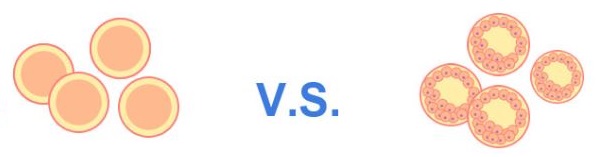

The clinical outcomes of different age using different treatment shown.
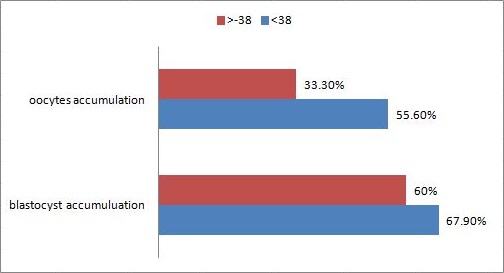
But the pregnancy rate of oocytes or blastocyst accumulation did not show a significant difference.
To conclude, for age under 38y/o, the pregnancy rate can be reached around 50~70% regardless of what treatment is used; however, forage over 38y/o, the pregnancy rate will be double using blastocyst instead of oocyte
the pregnancy rate of age over 38y/o is nearly double that of the ovulation pregnancy rate.
How many blastocysts should I collect?
Without pre-implantation genetic screening(PGS), the basis for embryo implantation can only be judged by the developmental speed and appearance level.
Therefore, the pregnancy rate and live birth rate vary with age.
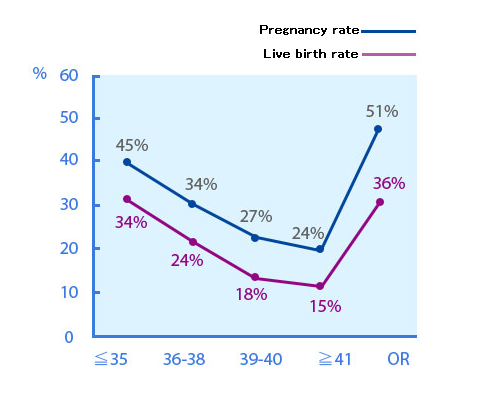
The estimated fee for both treatments is as follow.

To increase the pregnancy rate and live birth rate furthermore, we introduce you the Third generation IVF Plus( PGS + ERA) . For further require, please contact us
Leave a message down below, we are more than willing to answer!
 Register:Oversea Form
 Facebook:e-Stork FB Page
 E-mail:en_service@icryobank.com
 WhatsApp:+886-905-737-501
The best is yet to come
4/24/2017 02:52:00 AM
She was always gentle to the medical team.
Behind the smiling face,
We all knew the disappointments and frustration.
In the past six months,
No embryos were available for transfer.
She was a 45-year-old woman from Taiwan countryside, undergoing IUI five times and IVF twice. Still, no good news released. When she came to our clinic at the first time, she was arranged to take the oocyte-retrieval after two days for the observed dominant follicle. Unluckily, it was an immature oocyte. Since then, the fertility specialist recommended the natural-cycle IVF to her because of the declined ovarian function. No additional stimulation injections or oral alternatives were administrated, and supremon nasal solution was used as the trigger. From February to July in 2015, she visited the clinic almost every week, but no available embryo was collected.

She was always gentle to the medical team. Behind the smiling face, we all knew the disappointments and frustration. She told the doctor that she probably could not realize her dream. The fertility specialist encouraged her that there is not an only way to be a mother, and suggested her thinking about oocyte donation program.
Owing to the bountiful supply of oocyte bank at Stork Fertility Center, the matching process only took two months. In September of 2015, nine available blastocysts were derived and cryopreserved. Following with hysterosalpingography, hysteroscopy, and cervical bacteria culture, the doctor checked her uterine environment through several examinations. After the first cryotransfer, the beta-HCG showed negative. Her doctor ordered an auto-immune testing, and transferred her to the related specialists for further immune treatment.
In March of 2016, she took the second cryotransfer. The result was still upset. Why? Why? Why? She continuously asked the doctor and herself. Her specialist asked several questions about her life style after embryo transfer:
Her family owned a small business in Yilan. She needed to help and stand for a long time for the daily works. Although the doctor concerned the derived pressure to uterus, she refused to take a rest after transfer. The medical team did not give up and continue to convince her. Finally, she decided to grasp the chance.
The third cryotransfer was in July of 2016 after she arranged the backups for her family business. The fertility and immune specialists adjusted the post-transfer medications for her. She took two weeks for resting after the transfer and stayed at Hsinchu until the pregnancy test released. The beta-HCG showed positive this time, and the fetal heartbeat was detected after another three weeks later.
She was very happy and careful, coming back for the prenatal checks and related immune exams. In the 14 weeks of gestation, the non-invasive prenatal testing (NIPT) showed normal. Now, she was waiting for her healthy newborn.


