Stork Diary.
to Share Stork Life Events

PP-IVF (Personalized Precision IVF)


About IVF:
In Vitro Fertilization (IVF) is an assisted reproductive method wherein oocytes are fertilized by sperm outside of the womb, hence the word in vitro.
Louise Joy Brown is known for being the first IVF baby. People who was born by IVF up to now have been more than eight million, and there are 80,000 IVF cases in Taiwan. Taiwan Health Promotion Administration’s statistics in 2017 shows that in Taiwan, 3 out of 100 newborns are IVF babies.
Stork Fertility Center started to provide IVF procedures to patients in 1992. In 1993, a time frame of just one year, we announced our very first IVF baby. In the subsequent 18 years of our practice, we have already delivered thousands of healthy IVF babies.
**There are 9 out of 100 IVF newborns from Stork fertility center in Taiwan.**
The first IVF baby
UK
USA
Taiwan
Stork fertility center
Year
1978
1981
1985
1993

IVF3.0 plus (Third generation IVF Plus):
PP-IVF (Personalized Precision IVF) is the core treatment in Stork. According to individual situation, we plan the most suitable stimulating treatment to retrieve the best eggs in every menstrual cycle and then choose a blastocyst which is both good inside and outside through PGS test, as we call it “Precision Choosing”. Furthermore, IVF3.0+ means “Precision Choosing”(PGS) plus “Precision implantation”(ERA). According to Stork’s statistics in 2017~2018, the pregnancy rate of transferring one chromosome-normal blastocyst above grade BB can be 80%, which is the highest IVF pregnancy rate so far.

IVF Process:
Follicles stimulation → Oocyte retrieval → Pre-selection and incubation for fertlization  → Embryo transfer → Luteal function maintenance  →Waiting period for announcement of pregnancy → Embryo implantation in the uterine lining → Pregnancy confirmed → Child birth/ Delivery


IVF involves ovarian stimulation through oral medication or injections in order to increase follicle development. Once mature follicle count is ideal, oocyte retrieval is done using a thin, ultrasound-guided needle to harvest egg cells from the ovary under general anesthesia. Sperm is collected, washed and pre-selected.
Depending on the maturity rate of the oocyte, usually within 3-15 hours, the best quality oocyte shall be selected in order to be incubated in the laboratory with the sperm to induce fertilization. These will be closely observed within 15-17 hours in order to check if fertilization is successful. If yes, individual embryos shall be continued to be cultivated into blastocyst stage (5th-6th day), then a special designed tube shall be inserted into the inner uterus in order to transfer embryos.
 
Suitable candidiates for In Vitro Fertilization (IVF):


Couples must be legally married and healthy. Wife should have a normal uterus and husband should have sperm production (low count is acceptable). Couples experiencing any of the below problems can also utilize IVF to assist conception:

1) Both fallopian tubes for the oocyte to travel to the uterus are clogged.
2) Mild to moderate emdometriosis.
3) Infection of the pelvic area causing internal organ adherence.
4) Male factor such as low sperm count, low forward progressive motility, abnormal morphology, azoospermia (no sperms produced).
5) Immune rejection disorder.
6) Failure after 3-6 times of undergoing Intrauterine insemination.
7) Unexplained infertility.
8) Failure to achieve pregnancy even after 2 years of marriage with regular sexual intercourse.
9) Above 35 years of age and desiring to conceive with poor ovarian function.


Individualized COS for Stimulation:
Stork fertility center plan individualized treatment according to individual’s ovarian function.
AMH: Anti-mullerian hormone, index for ovarian function.
AFC: Antral follicle counts.

Injections:
Long-acting injection- Elonva came into being in 2011. On the 2nd-3rd day of the menstrual cycle, getting one shot of Elonva, then additional short-acting injections are needed before the oocyte retrieval operation. 


Insemination:
                                                                                                       
With regard to special patients who are senior, with poor ovarian function and performing egg cryopreservation, Stork usually defines precisely the timeline of the oocytes with spindle microscope to enhance the fertilization rate.

Implantation:

Medication for Implantation:

The pregnancy rate of women under 35 performing one-time IVF:
According to Stork’s statistic, the IVF pregnancy rate is related to “the quality of the blastocyst”. The successful rate of one-time blastocyst implantation for women under 38 years-old can reach up to 50~60%. That is, almost half of hundred couples can get pregnant by transferring only one time, and the other half of couples can realize their dreams by two or three more times transfer.

The IVF pregnancy rate depends on individual age, ovarian reserve, sperm quality, blastocyst quality, the way of implantation and the physical conditions.

Couples in Stork Fertility Center all perform blastocyst transfer, you can have high expectation if you have good-quality blastocyst with PGS test.

FAQ:
Will IVF result in fetal malformation?
There has been more than 8 million people born from IVF so far in the world. The deformity rate is almost the same as natural pregnancy. Most of the people who undergo IVF are advanced ages or with poor sperm quality, therefore they will bare higher risk than others. We suggest to do prenatal testing such as amniocentesis (at 16th weeks), and non-invasive methods, such as NIPT/NIFTY (at 10~12 weeks).

The possible risk and side effect of IVF?
Ovarian hyper-stimulation syndrome (OHSS) is the most common treatment-induced disease. Typical symptoms of OHSS include thirsty, abdominal bloating, feeling of fullness, nausea, oliguria, and shortness of breath. In order to prevent OHSS, the GnRH agonist as a latest trigger shot, and the frozen embryo transfer strategy will be performed to decrease the prevalence of OHSS near to zero.

Risks of multiple pregnancy:
The multiple pregnancy rate of IVF is about 20%, and most of them are twins. Customers in Stork fertility center usually transfer a single blastocyst with the best quality in the available embryos. In that way, we can decrease the risk of multiple pregnancy rate and also the twins rate can less than 3%.

Is it necessary to be in hospital after implantation?
NO need. Lying down for 30 minutes to 2 hours after implantation then take a good rest at home. Being in hospital and lying in bed all day won’t increase pregnancy rate which is related to the quality of blastocyst.

Post-embryo transfer:
-  Balanced diet and food with abundant protein, calcium, and vitamins are recommended.
-  Avoid doing heavy housework and abdominal-pressing posture.
-  Avoid sexual activities before pregnancy test.
-  Other activities in daily life are acceptable as usual.


 Register:Oversea Form

 Facebook:e-Stork FB Page E-mail:en_service@icryobank.com WhatsApp:+886-905-737-501


Stork Fertility Center Stork Fertility Center Author

PGD(PGT-M)-Preimplantation Genetic Diagnosis

PGD(PGT-M)-Preimplantation Genetic Diagnosis
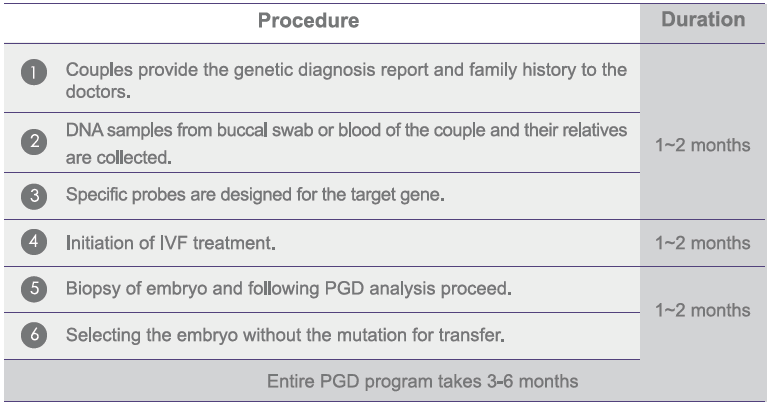
PGD (Preimplantation Genetic Diagnosis) is recommended for couples with known genetic mutation of inherited diseases. It involves specific probe design for the target mutation and following with genetic/linkage analysis on the embryos. 
Couples with a dominant or recessive single-gene genetic disease have a one-half or one-quarter chance of giving birth to children with the same genetic disease. Common diseases such as thalassemia, hemophilia, spinal muscular atrophy, cerebellar atrophy and ankylosing spondylitis, etc.
In order to avoid passing on this gene to the next generation, you can first collect blood samples from the family, confirm their gene mutation sites through the molecular genetics laboratory, design probes, and diagnose the biopsied cells from embryos to find out if there is embryo without specific gene that can be transferred.

Indication 
Spouse with known to have genes or chromosomes with genetic diseases, such as hemophilia, thalassemia, ankylosing spondylitis, cerebellar atrophy, etc.
PGD Program
PS. You can start IVF treatment first, then do PGS analysis after the probe design is done.
Common Diseases in PGD
*Hemophilia, thalassemia, ankylosing spondylitis, achondroplasia, spinal muscular atrophy, etc.
*If unlisted single-gene genetic diseases, please come to the clinic to discuss with the doctor whether the probe can be designed by molecular genetic laboratory.

PGD cases in Stork Fertility Center
Genetic Diseases
No. of cases
Thalassemia
10
Ankylosing Spondylitis
9
Hemophilia A
4
Spinocerebellar Ataxia, SCA3
1
Spinocerebellar Ataxia, SCA6
1
Phenylketonuria, PKU
1
Achondroplasia
1

Technical Limitations

PGD cannot detect unknown mutations, non hereditary diseases, and microdeletion/microduplication of chromosome. After undergoing PGD,the chorionic villus sampling or amniocentesis are strongly recommended during pregnancy. In some cases, it is unable to develop specific probes for the following PGD analysis.
Stork Fertility Center Stork Fertility Center Author

Social Egg Freezing in Taiwan


Start now with Stork Fertility Center!!


Social egg freezing is a result of advance reproductive technology. It allows us to preserve our fertility. The first human birth from a frozen oocyte was reported in 1986. It is 2020 now, the egg cryopreservation has advanced greatly over the years. Stork Fertility Center had been doing egg cryopreservation since 1992. We are currently using Vitrification to freeze and keep the oocytes. According to our latest data in 2019, our post-thaw survival rate can achieve to 95.9%.


Who is fit for social egg freezing:
-          Unmarried with low AMH index
-          35 year-old or above with no birth plan in the future few years
-          With a family history of premature ovarian failure or autoimmune diseases
-          Suffer from severe endometriosis and plan to have surgery
-          Plan to have chemotherapy or radiation treatment for treating tumor or cancer

Female age is the most crucial factor in the pregnant capacity, since it is closely related to the egg quality and quantity. According to the statistics from the Taiwan Health Promotion Administration, both the pregnancy and live birth rates dramatically decrease by age 35 in IVF women. In that case, you will need to spend more time and money in IVF at age 40 compare to age 35. Oocytes cryopreservation helps you to keep your eggs before it’s quality starts to drop rapidly after age 35.  

Procedure for social egg freezing
We start injection at our menstruation cycle day 3, with an ultrasound & blood test to monitor the grow of eggs at around cycle day 8-10. Oocytes retrieval surgery will be performing at day 12-14.

Our Advantage

Customized

  • According to personal conditions, design a course of freezing eggs.

  • The return visit/egg retrieval operation time is flexible.

  • Hospitals in Taipei, Hsinchu, and  cooperated with doctors in Taichung and Tainan.


Proud

  • Professional egg freezing and artificial reproduction medical team.

  • The number of frozen storage cases reaches thousands and the number of frozen eggs reaches more than 10,000.

  • 42-year-old egg frozen egg successful live birth case.

  • Frozen eggs for singles, successful pregnancy cases after marriage.

Professional

  • Adopt vitrification technology synchronized with Europe, America and Japan

  • New dry storage barrel, 24-hour electronic monitoring, stable storage environment

  • Rich experience, the results of frozen eggs are comparable to fresh eggs

  • IVF pregnancy rate and live birth rate are higher than the national average


Promise

  • The egg freezing consent form provides relevant protection.

  • Double confirmation, e-saving management.

  • APP keeps track of personal treatment course and egg status

  • “iVie” quarterly keep abreast of business trends


FAQ

  • Will frozen eggs be used?

There are not many things that can surpass the future. Egg freezing is one of them. Some people worry about “won’t use it”. This depends on “age” and “whether you want to get married”. If there is no stable relationship between the ages of 35 and 37, it means that the chance of marriage is not high at the age of 38 to 40. At this time, egg freezing is the right choice and the CP value is the highest. As empirical medicine shows that women’s egg quality declines rapidly at the age of 38, the cost doubles of IVF.

  • Do I have to get married to get pregnant with frozen eggs?

Yes, according to Taiwan’s Artificial Reproduction Law, a legal marriage relationship is required to implement artificial reproduction technology. Or you may choose to export your eggs abroad for related treatment services in the future.

  • How long can an egg be frozen?

Frozen eggs use vitrification technology to store eggs in a stable environment of liquid nitrogen at -196°C for a long time. Many studies have found that vitrification causes much less damage than slow freezing and has a survival rate of more than 90%. Therefore, there is no shelf life on the technical level.


  • Will an ovulation injection lead to earlier menopause?

No. The number of female eggs is determined at the moment of birth. There are already hundreds of thousands of eggs in the egg warehouse. During the growth period, in addition to the regular discharge of menstruation, other eggs will also self-deplete as the years grow.

Without the aid of any medication, the female hormones secreted in the body are only enough to supply 1 to 2 eggs to mature, and the remaining small follicles that are not selected will shrink on their own. The ovulation needle only provides enough hormones to allow these eggs to grow up and be taken out, and will not affect the inventory or premature menopause.

  • Are there any risks in egg retrieval surgery?

The most worrying risk after receiving ovulation induction treatment is "Ovarian Hyperstimulation (OHSS)", the incidence rate is less than 5%. Our hospital designs the most appropriate ovulation induction treatment according to your ovarian function, and matches with sustained ovulation injections and different Egg-breaking injections to greatly reduce the probability of OHSS.

  • Do I need to get pregnant via IVF after freezing eggs?

Yes. The ovulation injection treatment is carried out, and the young eggs are surgically removed and stored in advance. Wait until the right time, thaw the egg for subsequent fertilization (IVF treatment), and at the same time incubate in vitro for 3~5 days before implanting the good embryo into the mother's uterus. The whole pregnancy will not be completed until the healthy baby is born after term.

  • Will using frozen eggs affect the subsequent fertilization rate and pregnancy?

We adopt the Japanese Kuwayama vitrification technology, and successfully completed the first case of egg freezing in November 2009. Every year, more female friends continue to use this method to successfully fulfill their wish of becoming a mother.

In addition, according to the latest statistical analysis of this fertility center, the survival rate of frozen eggs is above 90%, and there is no significant difference between the fertilization rate, clinical pregnancy rate and implantation rate of fresh eggs. This shows that vitrification technology will not affect the eggs, and the potential for pregnancy is comparable.


Contact us now! We will design a personalized treatment for you and assist your through this wonderful journey.


 Register:Oversea Form

 Facebook:e-Stork FB Page E-mail:en_service@icryobank.com WhatsApp:+886-905-737-501

Stork Fertility Center Stork Fertility Center Author

Doing IVF overseas - getting started with Stork Fertility Center


STEP1. Contact Us
E-mail:en_service@icryobank.com
Upon Taiwan Artificial Reproduction Act, you need to prepare regarding documents to register IVF treatment in Taiwan, please contact our consultant team to request an appointment. We will place you a personal consultant and your consultant will evaluate your condition, help you with paper works and arrange examinations before you come to Taiwan.

STEP2. The First Visit

Both husband and wife need to come to Taiwan for the first visit. Usually the date would settled on day 7-11 of wife’s menstrual period so that you could finish all examinations which doctors suggest at one time. We will help you through the whole process which includes filling in agreements and examination.

Following are recommended examinations:

Blood Work:
  • Blood type: Confirm both husband and wife’s ABO and Rh type.
  • HIV and syphilis blood test for both husband and wife.
  • TSH,PRL- Wife only: If these two hormones exceed standard value, they will affect pregnancy rates and fetal development in gestation. You need to take medicines to control the level by the doctor's order.
  • Autoimmune-7 - Wife only: In a few people, their immune system attacks their embryo which leads to implantation failure and recurrent miscarriage. It can be diagnosed by analyzing antibody in the blood sample. Items including Anti-ATA, Anti-TPO, Anti-ENA, Anti-B2 glycoprotein IgM, Anti-B2 glycoprotein IgG, Anti-Cardiolipin IgM, Anti-Cardiolipin IgG and Lupus anticoagulant
Husband-
Semen Analysis and Cryopreservation:
We are going to analyze the sperm sample of the husband and the result will come out about an hour after collection. If the quality is good enough then the sperms would be cryopreserved for future insemination use. If the sperms’ quality does not meet the standard, the husband might need to visit our center more times to collect more or collect fresh sperm on the appointed insemination day. 
Wife-
Hysteroscopy:
Hysteroscopy is performed through a fiber optic lens with a diameter about 3 to 5 mm. It passes through the vagina, cervix, and then into the uterine cavity. It directly observes the internal environment of the cervix to the uterine cavity to see whether it is suitable for implantation. Then, through the image processing system, the lesion is enlarged 10 to 20 times and transmitted to the TV screen for clear observation and diagnosis. The examination process is almost painless, so no anesthesia is required. The whole process takes only 5 minutes.
If the physician find any abnormalities such as polyps that require further treatment, anesthesia is required. The surgery time depends on the difficulty of the treatment. 
3 in 1 test: 

3 in 1 test is to use a swab to collect a sample of mucous cells from endocervix to check if there is an infection caused by bacteria, chlamydia or HPV. If there is an infection, suppositories, ointments or taking antibiotics will be recommended.


HSG:
Hysterosalpingography is a minimally invasive procedure. The physician will inject small amount of contrast medium into your uterus and it will flow through your fallopian tube.Then an X-ray picture will be taken to check if your fallopian tubes are patent.

If hydrosalpinx or blocked, laparoscopic tubal ligation and medication therapy are suggested since the substances in tubes might flow to uterus to jeopardize the embryo.

--------
Final step for the first visit, we will arrange medication for your oocyte retrieval cycle. The consultant will tell you how and when to take your medication.  

After taking back all your medication, please keep close contact with your personal consultant. The consultant will help you settle your following schedule.


If you have further question or for more details, 
please contact us or leave a message down below, we are more than willing to answer!


Register:Oversea Form
Facebook:e-Stork FB Page

WhatsApp:+886-905-737-501
Stork Fertility Center Stork Fertility Center Author

POSTS